
Why is it that some have shorter legs, while others have longer ones?
When talking about Lambkin cats, one common question that may arise is. What is the difference between standard and non-standard Lambkin cats? Why is it that some have shorter legs, while others have longer ones? How does this affect the breed’s appearance and characteristics? And does every cat breeding organization accept both versions? Let’s dive deeper into the two types of Lambkin cats to explore what makes them unique.
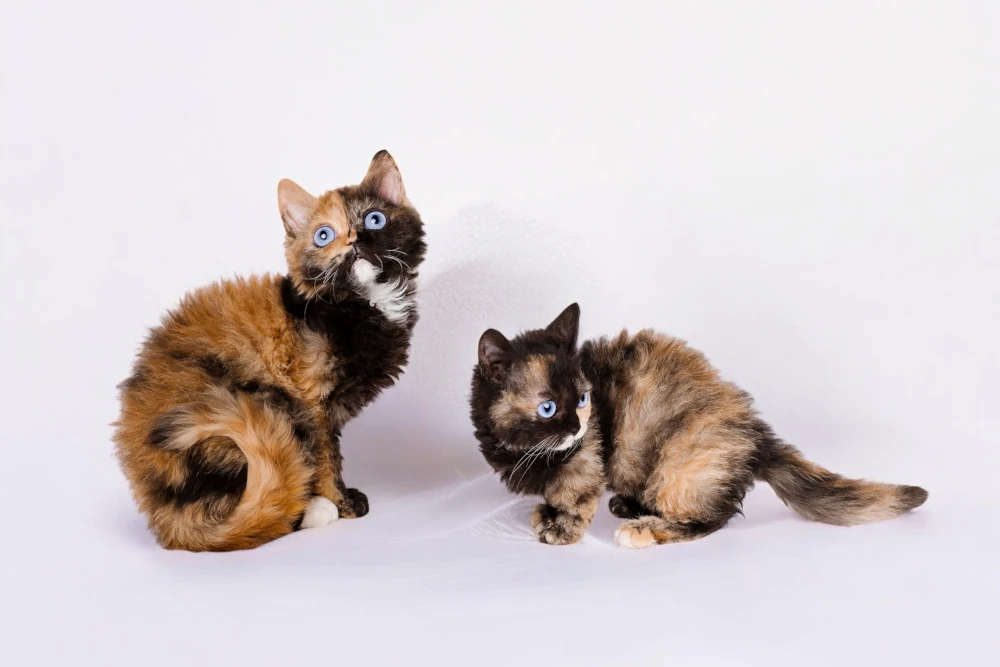
Short legs, long legs – What is the difference?
One of the most notable characteristics of the Lambkin cat is its short legs, which are caused by a dominant gene known as the “short legged” gene. If a kitten inherits this gene, it will have shorter legs. However, not every Lambkin kitten inherits this gene. Non-standard Lambkins, which have normal-length legs, are simply Lambkins that do not carry the short legged gene but still retain all the other defining traits of the breed, such as the curly coat.
It’s important to know that because the “short legged” gene is dominant, if two short-legged cats are bred together, it’s possible for their kittens to inherit both copies of the short legged gene. This combination is lethal, and the kittens will not survive past the embryo stage. Therefore, in ethical breeding practices, two short-legged Lambkins should never be bred together.
What makes standard and non-standard Lambkins special?
Both standard and non-standard Lambkin cats are incredibly unique, each with their own distinct qualities. The most obvious difference is in the leg length, but there may be other minor differences as well. Standard Lambkins, with their short legs, have a compact, distinctive appearance that many find appealing. Non-standard Lambkins, on the other hand, have longer legs and resemble a more “traditional” cat silhouette, though they still maintain the breed’s signature curly coat and personality.
Both versions of the Lambkin have the same wonderful characteristics: a curly coat, friendly temperament, and inquisitive nature. The differences don’t affect the breed’s health, but many find the short-legged Lambkins to be especially charming because of their adorable, unique look.
Which version is accepted by breeding organizations?
The WCF (World Cat Federation) is the organization that registers Lambkin cats, including both the standard and non-standard versions. This means that both types are officially recognized and accepted for breeding purposes. It’s worth noting that Lambkin cats are still extremely rare, regardless of whether they are standard or non-standard.
Is there a dominant blue-eyed Lambkin in both versions?
Yes, but dominant blue-eyed Lambkins are extremely rare, with only one or two known to exist worldwide. The blue-eyed variation is highly sought after by breeders and cat enthusiasts, and it holds a special place in the hearts of many. In our cattery, we proudly offer dominant blue-eyed Lambkin kittens, which are raised according to the highest breeding standards.
The dominant blue-eyed Lambkin has a truly magical and unique appearance that many people find captivating. There are very few such cats in the world, and breeding them requires careful, responsible planning.
Both versions of the Lambkin cat are special, and each deserves attention and affection. The primary difference between the standard and non-standard Lambkin lies in the leg length, but both types retain the breed’s signature curly coat and friendly personality. Dominant blue-eyed Lambkins are incredibly rare, with only one or two known to exist worldwide, making them even more sought after. If you are interested in Lambkin cats, our cattery offers these enchanting creatures, whether you’re looking for a standard or non-standard Lambkin or a rare dominant blue-eyed kitten.